The Picker’s Path Less Traveled
If you’ve ever watched shows like American Pickers or spent a Saturday morning wandering through yard sales, you already understand the basic concept of “picking.” A picker is someone who hunts for undervalued items with the intent to resell them for profit. Unlike casual shoppers or hobbyist collectors, pickers approach every sale, thrift store, and estate cleanout with a business mindset: What can I buy low and sell high?
Of course, many pickers blur the line between business and pleasure. You might start the day looking for items to flip, but if you stumble across a vintage concert poster from your favorite band or a first edition of a book you’ve always wanted to read, there’s no rule saying you can’t keep it for yourself. The beauty of picking is that it combines the thrill of treasure hunting with the satisfaction of turning a profit—and occasionally, you get to keep the treasure.
Now, here’s where things get interesting: mention “books” to most experienced pickers, and you’ll see them physically recoil. Ask about paper ephemera—old letters, postcards, documents—and they’ll probably laugh you out of the room. The conventional wisdom in the picking community is clear: books are heavy, take up space, and rarely sell for enough to justify the effort. Paper ephemera? That’s just junk that should’ve been thrown away decades ago.
But here’s what those pickers are missing: books and paper goods offer some of the highest return on investment (ROI) in the entire picking game. A $2 book can easily sell for $50, $100, or even more. A box of “old letters” purchased for $5 at an estate sale might contain Civil War correspondence worth thousands. And unlike furniture or vintage electronics, books and paper are incredibly easy to ship—no special packaging, no freight companies, just a padded envelope or small box.
The pickers who avoid books and ephemera aren’t wrong about the challenges—there’s definitely a learning curve, and you can’t just grab any old book and expect it to sell. But once you understand what to look for, you’ll have access to a category that most of your competition is completely ignoring. That’s the definition of opportunity.
This guide will teach you everything you need to know to start flipping books and ephemera profitably. We’ll cover how to spot valuable items quickly, what tools you need (spoiler: not many), and most importantly, what to avoid so you don’t waste money on worthless inventory. Whether you’re a seasoned picker looking to expand into a new category or a complete beginner who just loves the idea of turning old books into cash, you’re in the right place.
Let’s get started.
The Low-Hanging Fruit – How to Spot Obvious Winners
When you’re starting out, you don’t need to become an expert on every obscure author or publishing house. Instead, focus on categories that consistently deliver value and are relatively easy to identify. These are your “low-hanging fruit”—items that even beginners can spot and flip successfully.
Textbooks: The Reliable Money-Maker
College textbooks are the bread and butter of many book flippers, and for good reason. Students need specific editions for their courses, and they’re willing to pay significantly less than bookstore prices to get them. A textbook that retails for $200 new might sell used for $80-120, and you can often find these same books at thrift stores for $3-5.
The key is focusing on current editions. Textbooks are updated frequently, and last year’s edition is often worthless. Use your phone to quickly check if the edition you’re holding is still being used. Look for subjects that don’t change much year-to-year (mathematics, statistics, anatomy) rather than rapidly evolving fields where textbooks become outdated quickly.
Science, technology, engineering, and mathematics (STEM) textbooks tend to be the most valuable. Medical textbooks, nursing guides, and professional exam prep books (CPA, bar exam, engineering licensing) are also excellent finds. Even if a textbook is a few years old, it might still have value to students at smaller colleges or international buyers.
Weird Religious Books: The Unexpected Goldmine
Here’s something most pickers don’t know: obscure religious texts, especially older ones, can be surprisingly valuable. We’re not talking about common Bibles or mass-market devotional books—those are usually worthless. Instead, look for:
- Denominational histories and theological texts from smaller religious movements
- Vintage Sunday school materials and illustrated children’s religious books from the early 1900s
- Books about cults, alternative religions, or religious movements (these attract academic buyers)
- Foreign language religious texts, especially in less common languages
- Leather-bound religious books from the 1800s, even if they’re common titles
Why are these valuable? Collectors, religious historians, and academic libraries actively seek these materials. A obscure denominational history from 1920 might sell for $40-80, even though you found it in a thrift store for $2. The market is niche but passionate.
Signed Copies: Instant Value Boost
A signature can transform a $5 book into a $50, $500, or even $5,000 book, depending on the author. The challenge is knowing whether a signature is authentic and whether it actually adds value.
First, understand that not all signatures are created equal. A signed copy of a book by a living author who does frequent book tours might only add $10-20 to the value. But a signed first edition by a major author, especially one who’s deceased or rarely signed books, can be worth serious money.
When you find a signed book, look for:
- Inscriptions or dedications (these can add or subtract value depending on the buyer)
- Authentication marks (some authors use specific colored pens or add drawings)
- Condition of the signature (faded signatures are less desirable)
Be cautious of forgeries, especially with highly collectible authors like Stephen King, J.K. Rowling, or Ernest Hemingway. If you find what appears to be a signed first edition of a major work, it’s worth getting it authenticated before selling.
First Editions of Notable Books
This is where book flipping gets more advanced, but there are some easy wins. First editions of books that became movies, won major awards, or are by authors who later became famous can be quite valuable—even if they weren’t valuable when published.
You don’t need to memorize every important book ever written. Instead, develop a mental list of “always check” authors: Stephen King, Cormac McCarthy, Toni Morrison, Margaret Atwood, Haruki Murakami, and other literary heavy-hitters. If you see their books, especially older hardcovers, take a moment to check the copyright page for first edition indicators.
Vintage Children’s Books
Illustrated children’s books from the early-to-mid 20th century are highly collectible, especially first editions or books with dust jackets intact. Look for:
- Little Golden Books (first editions and certain titles)
- Dr. Seuss first editions
- Beatrix Potter books
- Illustrated fairy tale collections
- Vintage pop-up books in good condition
Condition is especially important with children’s books since they were typically well-used. A pristine copy can be worth 10x more than a worn one.
Ephemera 101 – Why That Box of Old Letters Is Worth More Than the Antique Lamp
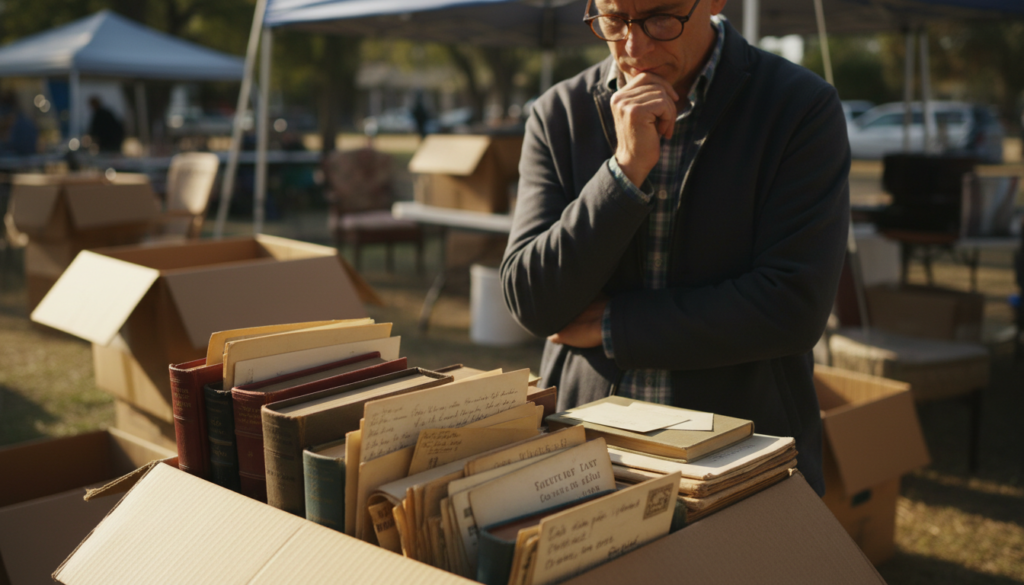
Most pickers walk right past boxes of old paper at estate sales. They’re looking for furniture, vintage tools, collectible glassware—tangible items that look valuable. Meanwhile, that dusty box of letters, postcards, and documents sitting in the corner might be the most profitable item at the entire sale.
What Exactly Is Ephemera?
Ephemera refers to paper items that were created for temporary use—things that were meant to be thrown away after serving their purpose. This includes:
- Letters and correspondence
- Postcards
- Photographs
- Advertising materials (posters, trade cards, flyers)
- Tickets and programs
- Maps and travel brochures
- Receipts and invoices
- Newspapers and magazines
- Labels and packaging
- Greeting cards
- Menus
The irony is that because these items were disposable, relatively few survived. That grocery receipt from 1920 that nobody bothered to save? It’s now a rare artifact. The postcard someone sent from Paris in 1905? It’s a collectible piece of history.
Why Ephemera Is So Valuable
Ephemera offers something that formal historical records often can’t: authenticity and intimacy. A handwritten letter from a Civil War soldier tells you what he ate, how he felt, what he missed about home—details that don’t make it into history books. A 1950s restaurant menu shows actual prices and popular dishes of the era. These items are unfiltered snapshots of daily life.
Different types of ephemera appeal to different collectors:
- Historical researchers and museums want documents related to significant events or time periods
- Genealogists seek letters, photos, and documents related to specific families or regions
- Advertising collectors hunt for vintage trade cards, posters, and product packaging
- Postcard collectors focus on specific locations, themes, or time periods
- Autograph collectors want signed letters and documents from notable people
How to Evaluate Ephemera Quickly
When you encounter a box of old paper, you need to make a quick decision: is this worth buying, or is it genuinely just trash? Here’s a rapid assessment method:
1. Check for dates. Anything pre-1900 is worth examining closely. Items from 1900-1950 are often valuable. Post-1950 items need to have something special about them (famous person, significant event, etc.).
2. Look for signatures or names. Even if you don’t recognize the name, someone might. Letters signed by local politicians, business leaders, or military officers can have value.
3. Scan for keywords. Words like “war,” “railroad,” “mining,” “slavery,” “suffrage,” or specific historical events indicate potential value.
4. Assess visual appeal. Illustrated postcards, colorful advertising materials, and photographs are easier to sell than plain text documents.
5. Consider the volume. A single random letter might be worth $5-10. A collection of 50 letters from the same person or family could be worth $200-500 or more.
The Hidden Value in “Boring” Documents
Don’t dismiss documents just because they seem mundane. Business correspondence, legal documents, and financial records from the 1800s and early 1900s can be valuable to researchers and genealogists. A deed from 1880, a receipt from a long-defunct business, or a letter discussing everyday life in a specific town—these all have buyers.
The key is understanding that you’re not just selling paper; you’re selling history, research material, and connections to the past.
The Tool Stack – You Need a Scanner, a Box Cutter, and The Paper Analyst App
One of the best things about flipping books and ephemera is that you don’t need much equipment. Unlike furniture flipping (which requires trucks and tools) or electronics flipping (which requires testing equipment), paper goods require minimal investment. Here’s what you actually need:
A Smartphone with Internet Access
This is non-negotiable. Your phone is your research tool, your camera, and your connection to pricing databases. At sales, you’ll use it to:
- Look up books on Amazon, eBay, or book-specific platforms
- Check sold listings to see what items actually sell for
- Photograph items for later research
- Use apps to identify first editions and valuable ephemera
A Barcode Scanner (Optional but Helpful)
Many book flippers use barcode scanner apps or dedicated Bluetooth scanners to quickly check book values. You scan the ISBN barcode, and the app shows you current market prices. This speeds up the process when you’re sorting through large quantities of books.
However, be aware that older books (pre-1970s) often don’t have ISBN barcodes, and ephemera never does. That’s where visual assessment and specialized tools become important.
The Paper Analyst App: Your Secret Weapon
Here’s where most book and ephemera flippers hit a wall: identifying first editions requires knowledge of publisher-specific codes, and deciphering old handwritten documents is time-consuming. You can spend years learning these skills, or you can use technology to level the playing field immediately.
Book & Paper Analyst is specifically designed for pickers and collectors who need fast, accurate information about books and paper documents. Here’s what makes it essential:
First Edition Identification: Snap a photo of a book’s copyright page, and the app analyzes the number lines, publisher codes, and edition statements to tell you if you’re holding a first edition. No more memorizing different publishers’ systems or second-guessing yourself.
Handwriting Recognition: That box of old letters written in faded cursive? The app can read handwritten documents and extract text, making it possible to quickly scan for valuable keywords, names, or historical references without spending hours deciphering each page.
Document Type Identification: The app recognizes different types of documents—letters, receipts, legal documents, postcards, etc.—and can flag potentially significant items based on keywords and context.
Famous Document Recognition: Perhaps most exciting, the app can identify potentially famous or historically significant documents. That signature you’re not sure about? That letter that mentions a historical event? The app can help you determine if you’ve found something truly special.
Think of Book & Paper Analyst as having an expert looking over your shoulder at every sale. It doesn’t replace your judgment, but it dramatically speeds up your learning curve and helps you avoid missing valuable items.
A Box Cutter and Packing Tape
Once you start selling, you’ll need to ship items. A good box cutter and quality packing tape are essential. You’ll also want padded envelopes in various sizes and some cardboard for protecting book covers during shipping.
Storage Solutions
Books and paper need to be stored properly to maintain condition. Invest in some plastic storage bins to protect inventory from moisture and pests. Keep items organized by category or value so you can find things quickly when they sell.
The “No-Go” List – What to Leave Behind
Knowing what NOT to buy is just as important as knowing what to buy. Every picker has made the mistake of purchasing items that seemed promising but turned out to be worthless. Here’s your guide to avoiding the most common book and ephemera traps:
Reader’s Digest Condensed Books
These are everywhere—thrift stores, yard sales, estate sales. They’re usually in good condition with attractive covers. And they’re almost completely worthless.
Reader’s Digest Condensed Books contain shortened versions of multiple novels in a single volume. They were incredibly popular from the 1950s through the 1990s, which means millions were printed. There’s virtually no collector market for them, and readers don’t want abridged versions when they can get the full book.
Leave them on the shelf, no matter how nice they look.
Encyclopedia Sets
Unless you’re looking at a genuinely antique set from the 1800s or very early 1900s, encyclopedia sets have no value. The information is outdated, they’re heavy and expensive to ship, and nobody wants them. Even complete sets of Encyclopedia Britannica from the 1970s-1990s are essentially worthless.
The only exceptions are very old sets with historical or decorative value, or specialized encyclopedias on specific subjects (like a vintage medical encyclopedia) that might appeal to niche collectors.
Book Club Editions
Book clubs like the Book-of-the-Month Club produced special editions of popular books for their members. These look similar to first editions but are worth significantly less. You can usually identify book club editions by:
- Lack of a price on the dust jacket
- Smaller size than the trade edition
- “Book Club Edition” printed on the dust jacket or copyright page
- A small debossed mark (blind stamp) on the back cover
Some book club editions have modest value, but they’re generally not worth your time unless it’s a particularly desirable title.
Mass Market Paperbacks (Usually)
Those small, pocket-sized paperbacks you see everywhere? Most are worth pennies. The exceptions are:
- First printings of books that became extremely famous
- Vintage paperbacks from the 1940s-1960s with great cover art
- Specific collectible imprints (like vintage Penguin paperbacks)
Unless you know you have one of these exceptions, skip the mass market paperbacks.
Modern Hardcovers Without Dust Jackets
For books from the 1950s onward, the dust jacket is crucial to value. A first edition without its dust jacket might be worth 10% of what it would be worth with the jacket intact. Unless the book itself is extremely significant, pass on modern hardcovers missing their dust jackets.
Water-Damaged or Heavily Worn Books
Condition is everything in book selling. Water damage, torn pages, heavy writing or highlighting, musty odors, and broken bindings all make books very difficult to sell. Even if you’re looking at a potentially valuable title, severe condition issues can reduce the value by 80-90% or make the book completely unsellable.
Be realistic about condition. Minor shelf wear is fine, but significant damage is a deal-breaker.
Common Ephemera
Not all old paper is valuable. Items that were mass-produced and commonly saved have little value:
- Newspaper clippings from major papers (unless about significant events)
- Modern greeting cards (post-1970)
- Photocopies or printed reproductions
- Generic postcards from tourist locations (post-1960)
- Mass-produced posters and prints
Look for items that are genuinely old, unique, or connected to specific people, places, or events.
Now What? Your Next Steps
Flipping books and ephemera isn’t a get-rich-quick scheme, but it is a legitimate way to make money doing something genuinely interesting. You’ll learn about history, literature, and culture while building a profitable side business. And unlike many other forms of picking, you can start with minimal investment—just your knowledge, a smartphone, and a willingness to dig through boxes at estate sales.
Start small. Buy a few books at your next thrift store visit. Download Book & Paper Analyst and practice identifying first editions. Check sold listings on eBay to see what similar items actually sell for. List your first few items and learn the selling process.
As you gain experience, you’ll develop an eye for valuable items. You’ll learn which authors, publishers, and types of ephemera are worth your time. You’ll build relationships with estate sale companies and thrift store managers who’ll give you first access to new inventory.
Most importantly, you’ll be doing something that most pickers are completely ignoring—which means less competition and more opportunity for you.
Now get out there and start flipping.
Leave a Reply