
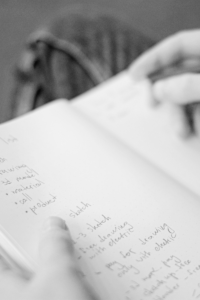
Since the dawn of recorded history, humans have sought ways to leave their mark. From the earliest cuneiform etched into clay to the elegant calligraphy of the Renaissance, the act of writing by hand has been the primary vehicle for human thought, history, and emotion. While the 21st century has ushered in an era of unprecedented digital efficiency, the humble pen remains one of our most powerful cognitive and creative tools. Far from being an obsolete relic, handwriting offers unique neurological and personal benefits that keyboards simply cannot replicate.
The Neurological Symphony of Writing
Recent scientific research has begun to quantify what many writers have long felt: writing by hand engages the brain in a fundamentally different way than typing. As NPR reports, neuroscientists have found that handwriting is one of the most complex motor skills the human brain can perform. Unlike the uniform, repetitive motion of pressing keys, handwriting requires a sophisticated coordination between the motor and visual systems.
When you write by hand, your brain must continuously monitor the pressure of your fingers and the precise movement required to form each unique letter. This complexity causes different parts of the brain to “sync up.” Brain imaging studies show that handwriting activates areas involved in motor processing and visual information, which in turn fire at frequencies associated with learning and memory formation.
For students and professionals alike, this means that taking notes by hand isn’t just a slower way to record information; it’s also a more effective way to process and retain it. The physical act of forming letters creates “neural hooks” that help the brain retrieve information later.
A Different Kind of Creativity
Choosing to write by hand does not mean rejecting modern technology. Computers and smartphones are indispensable for editing, long-form production, and instant communication. However, handwriting offers a different “mode” of expression. Because it is naturally slower, it forces the writer to pause and think more deeply about their word choices. This deliberate pace can act as a meditative practice, reducing the “digital noise” and allowing for a more focused flow of ideas.
Many famous authors, such as Neil Gaiman and Jennifer Egan, still choose to draft their first versions by hand. They find that the tactile connection between the hand and the page stokes a specific kind of creativity that a blinking cursor can sometimes stifle. Handwriting allows for a non-linear expression of thought—you can scribble in the margins, draw arrows between ideas, or sketch a quick diagram—making the page a truly flexible canvas for the mind.
The Joy of the Tangible: Vintage Pens and Stationery
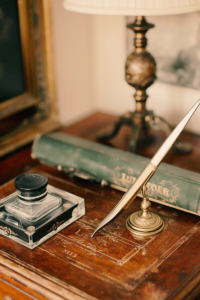
Beyond the cognitive benefits, there is a profound aesthetic and sensory joy in the practice of handwriting. In a world of mass-produced plastic and digital pixels, using an antique fountain pen or a piece of heavy, textured stationery feels like a return to craftsmanship. There is a unique thrill in finding a vintage pen that has its own history and character, or in choosing a specific ink color that reflects your mood.
The “feedback” of a nib on paper—the slight scratch or the smooth glide—provides a sensory satisfaction that a glass screen cannot offer. Collecting vintage writing instruments and high-quality paper transforms a mundane task into a hobby and a form of self-care. It turns a simple thank-you note or a journal entry into a personal artifact, something that carries the physical weight of the person who created it.
BROWSE VINTAGE PENS, INKWELLS, & STATIONARY
Take Part in a Timeless Tradition
Handwriting is more than just a way to record words; it is a bridge between our physical bodies and our mental worlds. By engaging our brains more deeply, slowing our thoughts, and allowing us to interact with beautiful, tactile objects, it enriches our lives in ways that digital tools cannot. Whether you are a student trying to master a new subject or a creative looking for a fresh perspective, picking up a pen might be the mosthigh-tech thing you can do for your brain today.
Leave a Reply